How to make morijio, and what it means
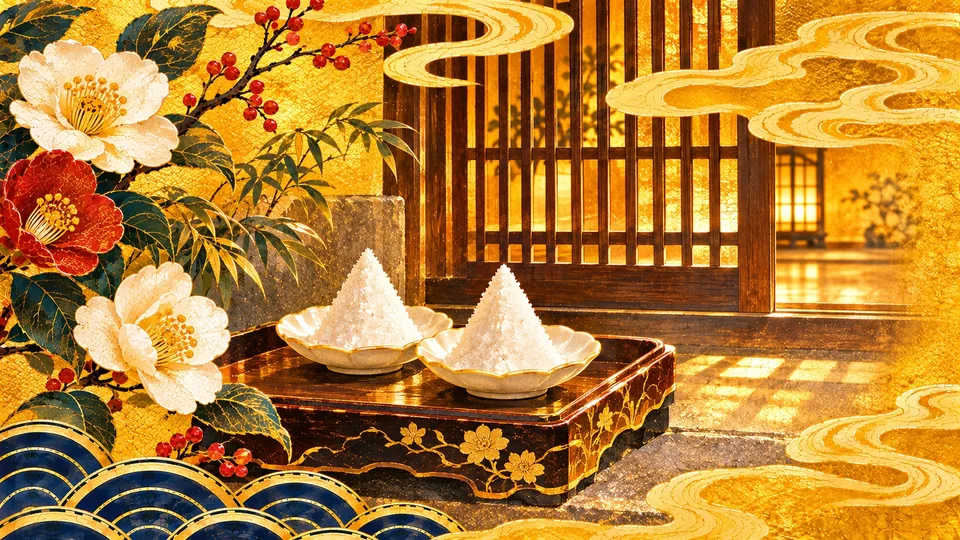
Morijio, “heaped salt”, is a Japanese custom of shaping salt into a small cone or similar and placing it at the entrance or in the corners of a room. It is said to purify a space and invite good qi, and it often appears in books on feng shui and kasō.
On this page
1.Where it comes from
There are several theories. The best known is a story about Emperor Wu of the Jin dynasty in China, who toured his harem in a cart drawn by goats. One palace lady stuck bamboo leaves in her doorway and sprinkled salt water, so that the goats stopped there and brought the emperor to her (Book of Jin, biographies of empresses and consorts). In Japan, this is often told as a story of “heaped salt”. Salt has also long been thought in Japan to have the power to purify, an idea seen in Shinto rites, the purifying salt used after funerals, and the salt sumo wrestlers throw.
2.What you need
- Salt: natural coarse sea salt is said to be better than refined salt.
- A dish: a small white dish is usual; unglazed or ceramic mini dishes are also popular.
- A mold: molds that press the salt into a cone or an eight-sided pyramid are sold. You can also make one from rolled paper.
3.How to make it
- Add just a little water to the salt, with a mist spray for example, so it is slightly damp
- Pack it firmly into the mold
- Turn the mold over onto the dish and lift it off gently
A cone or an eight-sided pyramid is the usual shape. The octagon is said to stand for feng shui’s eight directions.
4.Where to put it
| Place | How |
|---|---|
| Entrance | A pair, either side of the door outside, or either side of the entrance floor inside |
| Toilet and water areas | In a corner of the floor or on top of the cistern, out of the way of cleaning |
| Demon gate and rear demon gate | In the northeast and southwest corners of the home |
| The four corners of a room | In corners where qi tends to collect |
The demon gates are explained in directions and the eto.
5.How often to change it, and how to dispose of it
- As a guide, change it on the 1st and 15th, or once a week. Change it if it hardens or melts in the damp.
- Wrap used salt in white paper and put it out with burnable rubbish, or dissolve it in water and pour it away.
- Give the dish a quick wash and let it dry before heaping new salt.
6.Points to watch
- Morijio soaks up moisture, so if it is left for a long time the area around it can be damaged.
- In homes with pets or small children, put it where it can’t end up in a mouth.
- Morijio is a kind of “charm”. Don’t just put it out and relax; cleaning and airing come first.
Other ways to purify are collected in ways to purify a space.
Yorozu Goyomi’s shop is also preparing everyday items such as small ceramic dishes.
7.FAQ
How often should I change morijio?
There is no fixed rule, but changing it on the 1st and 15th of the month, or once a week, are common guides. If it hardens in the damp or gets dirty, change it sooner.
Can I cook with the used salt?
Salt used for purification has soaked up dust and moisture, so the usual practice is not to cook with it. Wrap it in paper and throw it away, or dissolve it in water and pour it away.
Can I use it in a home with pets or small children?
Salt can be bad for pets that lick it. Put it somewhere high out of reach, or skip it and purify the space by cleaning and airing instead.
Now try a reading for yourself
Free readings related to this article.
Read next